
Teterin’s agricultural empire
Authors

For years, Aleksandr Lukashenko has presented his lesser motherland, Kopys in the Orsha District, as an exemplary “village of the future.” Delegations were brought there to showcase improvements and the opening of artisanal production centres and new industries, intended to demonstrate the state’s ability to revitalise the province.
However, Buro discovered that Aleksandr Lukashenko’s close friend, Sergei Teterin, was simultaneously acquiring land, real estate, and production facilities in the area.
A private agro-empire has sprung up under the guise of farming business in three nearby villages: Kopys, Khimy, and Aleksandryja. This empire includes fields, orchards, a cheese factory, a bakery, and a meat processing plant, as well as the management of state agricultural assets.
KOPYS REVIVAL
In July 2017, Lukashenko visited Kopys, his lesser motherland, and announced that it would serve as a model for transforming villages across the country. He stated that the authorities “must save” small towns and unpromising villages. After that, Kopys has been consistently transformed into a showcase “village of the future,” displaying urban upgrading, local industry, and regional revitalisation.
But what is the true cost of the “Kopys revival”? It’s nearly impossible to calculate directly. However, Buro found several examples and cost estimates for developing a township of 600 people.
Thus, in December 2017, Lukashenko amended the national budget through a decree and allocated nearly 10 million Belarusian rubles from the National Development Fund for the “development of Kopys.” This amount was allocated for only one year. Another project involves transferring wastewater from Kopys to Orsha. The budget for 2019-2023 was just over 6 million rubles. That brings the total for the two known subsidies to 16 million rubles.
However, the state was not the only entity involved in building the “village of the future.” The story of how Lukashenko’s friend created an agro-empire and became the head of the Belarusian Tennis Federation in 2017 is inextricably linked to Kopys as a political project of the Belarusian authorities.
Buro identified and analysed all of the businesses and holdings of Lukashenko and his friend, Sergei Teterin, in the villages of Khimy, Kopys, and Aleksandryja.
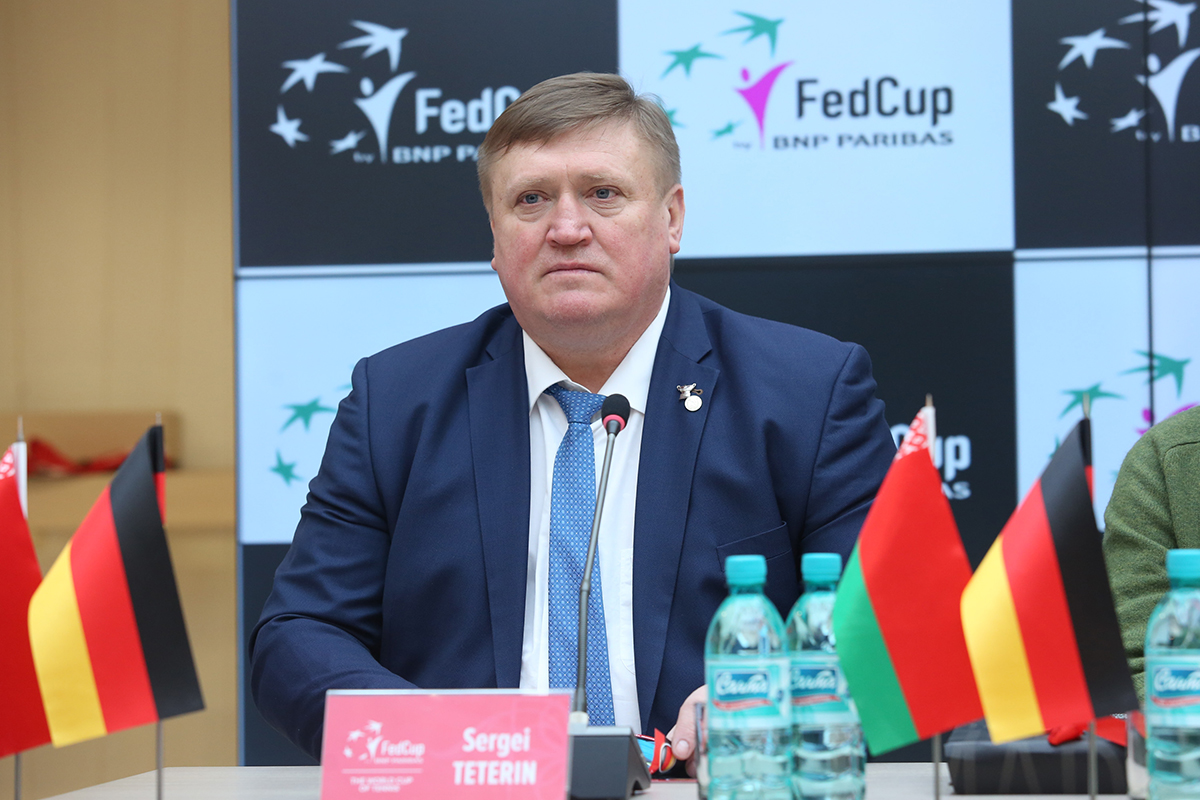
Sergei Teterin. Source: belta.by
FRIENDSHIP WITH LUKASHENKO
Who is Sergei Teterin? He is a former athlete and coach who introduced Aleksandr Lukashenko to professional tennis in the 1990s.
Since then, Teterin has become one of the most prominent figures in Lukashenko’s inner circle, outliving many of his former associates. For many years, he regularly appeared alongside Lukashenko at sporting events and the Slavianski Bazaar art festival. Together, they mowed grass, collected watermelons and potatoes, participated in community clean-ups, and chopped wood.
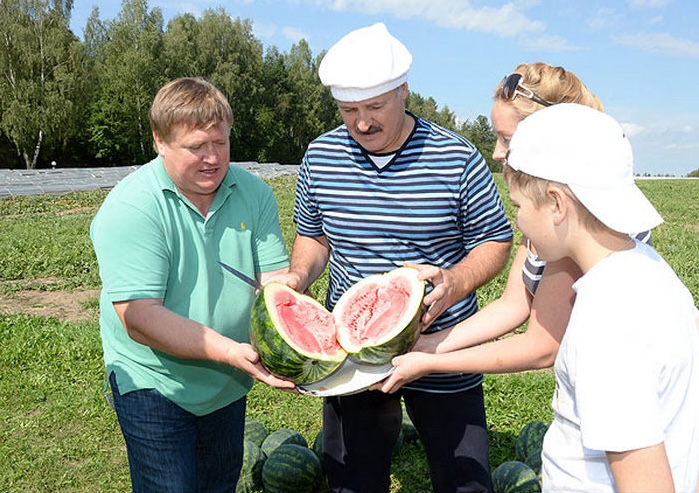
Sergei Teterin and Aleksandr Lukashenko harvesting watermelons. Source: belta.by
They also enjoy drinking together. In 2012, while Lukashenko was on vacation in Sochi, Sergei Teterin informed him of Victoria Azarenka’s victory at the Australian Open. Lukashenko responded by rushing to hug Teterin and shout, “Pour!” “Pour!” A similar scene unfolded after Aryna Sabalenka’s victory at the 2023 Australian Open. They sat at the same table, clinking glasses, and Teterin raised his to toast: “To our country and its president!”
Gifts were also part of the relationship. Thus, Sergei Teterin gave Lukashenko’s Security Service a silver 1954 Rolls-Royce through one of his companies. The car was estimated to be worth $100,000 at the time.
Sergei Teterin held senior positions in the sports sector and the power hierarchy while maintaining this friendship. He was the first deputy minister of sports and tourism, assistant to the president, director of the Raubichy Olympic Sports Complex, vice-president of the National Olympic Committee, and head of the Belarusian Tennis Federation.
The businessman was placed under personal EU sanctions in June 2021 for his ties to Aleksandr Lukashenko.
Over the years of his friendship with Lukashenko, Teterin has built up a wide network of companies across different sectors, including cinema bars, import operations, advertising, vehicle sanitation services at the border, construction, and agriculture.
The former tennis player often promoted his projects by writing personal letters to Lukashenko, requesting special conditions. Lukashenko’s role in these businesses was to establish a system of privileges and exclusive access. For instance, by Lukashenko’s decree, Teterin was granted the exclusive right to mandatory vehicle disinfection at border crossings.
One of the businessman’s projects is a farm near Kopys, Aleksandr Lukashenko’s hometown.
GATHERING OF THE LANDS
Sergei Teterin’s farming empire began in Khimy, a small village just a few kilometres from Kopys and Lukashenko’s residence in Aleksandryja.
Ironically, Khimy was the previous settlement intended to become a “model for the entire country.” In 2011, Aleksandr Lukashenko announced plans to transform the village of Khimy into a prosperous centre and the agro-industrial complex by 2025. By a twist of fate, Sergei Teterin’s farm actually became the agro-industrial complex.
Sergei Teterin registered a farm in Khimy in May 2018. Initially, he referred to it by his patronymic, Semyonych, but later switched to a more mundane moniker: Start TS. Then, he began to gather more land.
The first known plot transferred to Teterin is dated June 2018. It is 0.5299 hectares in size and is located near the village of Khimy. It is intended for “peasant farming” and is held under lifetime heritable tenure. Teterin paid 168 rubles to the Orsha bread-baking plant for the transfer of this land. In just a few months, in the fall of 2018, Sergei Teterin was filmed picking watermelons and potatoes alongside Aleksandr Lukashenko.
The following year, the land acquisition process sped up sharply. In 2019, Teterin received six plots totaling 13.3 hectares under lifetime inheritable tenure.
In 2020, the District Executive Committee continued seizing land in the neighbourhood and transferring it to Teterin. This time, it was plots totalling 2.2319 hectares. The farmer reimbursed the lost profit, amounting to 1.16 rubles, as reported by the Orsha District Executive Committee.
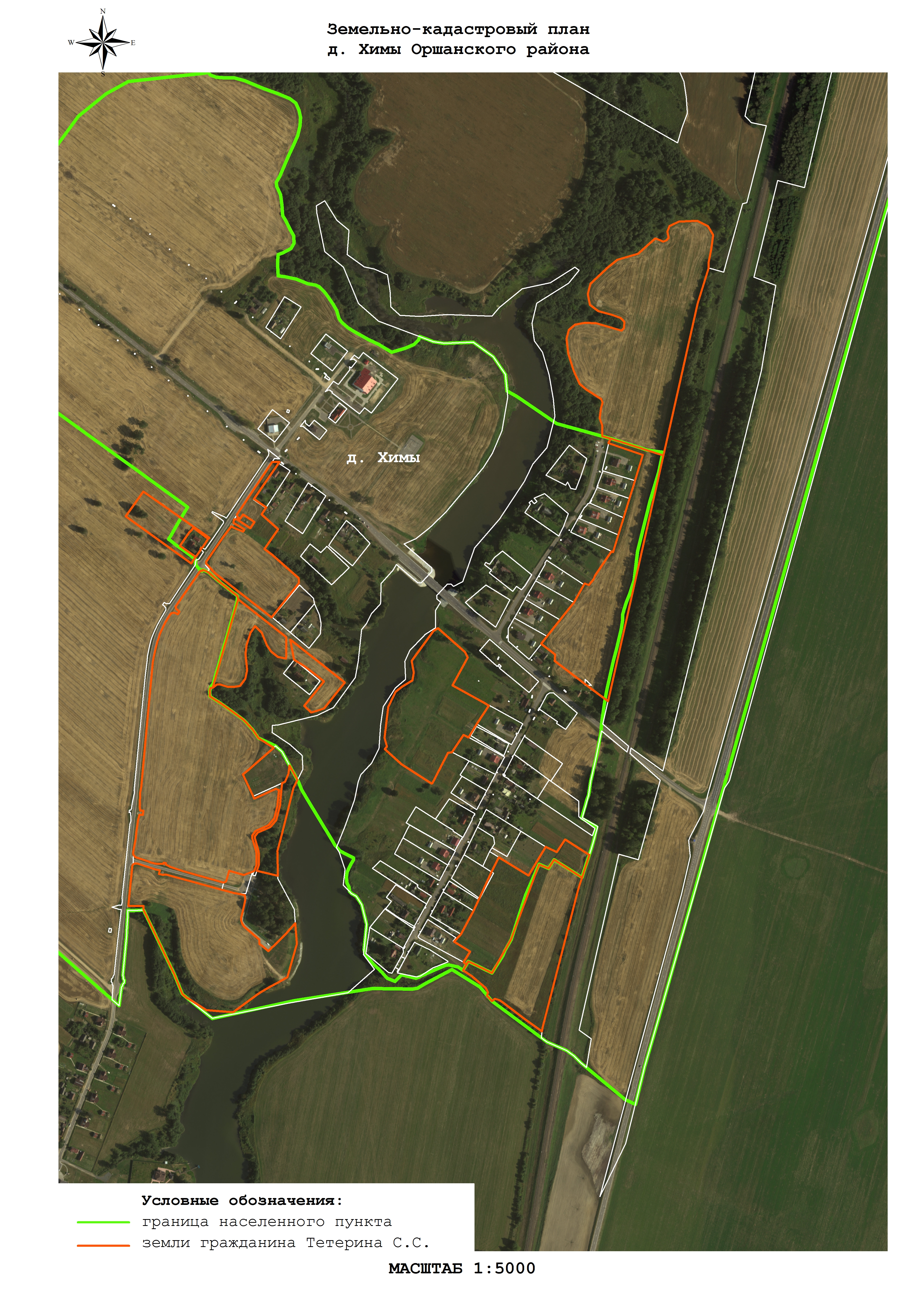
From 2018 to 2021, we counted 14 plots transferred to Sergei Teterin under lifetime heritable tenure, totalling nearly 30 hectares.
The land cadastral plan provides a complete picture. Orange indicates Teterin’s lands, while green shows the settlement boundary. Khimy is almost surrounded with Teterin’s possession.
In 2022, Lukashenko admitted that he had asked businessman Sergei Teterin to revitalise Khimy and praised Teterin for his efforts to restore the village.
“He bought them [the plots] out. It’s an exemplary village. He put everything in order, restored the houses, and built new ones elsewhere. Now people are lining up to come vacation there.”
REAL ESTATE IN KHIMY AND THE HONORARY CONSUL’S OFFICE
Teterin’s ambitions extended beyond mere land acquisitions. As of March 2021, Start TS’s balance sheet included a wide variety of plots and buildings.
On February 12, 2021, the farm sent a letter to the Orsha branch of the Vitsebsk Agency for State Registration and Land Cadastre. The letter listed five facilities built in 2020 in the village of Khimy, valued at 596,000 rubles at that time. The facilities include houses with saunas, gazebos, cellars, and other structures.
Sergei Teterin leases this property, paying 52 rubles annually. Lease terms range from 50 to 100 years.
We found correspondence, contracts, and payment records between the Start TS farm and Zavod Gazetnoy Bumagi among the documents available to Buro. They show that, from 2019 to 2020, the Teterin farm purchased ready-made construction solutions from the factory, including houses, bathhouses, and extensions. The key contracts were drawn up for Start TS as the buyer, but Teterin personally paid some of the obligations as an individual.
Sergei Teterin also owns an estate in neighbouring Aleksandryja, located next to Aleksandr Lukashenko’s residence. The local executive committee transferred the 0.2498 hectare plot to Teterin in 2013, granting it to him under lifetime heritable tenure. Teterin’s office as an honorary consul of Georgia in Belarus was also located there. However, in April 2026, it was revealed that Sergei Teterin no longer holds this position.
SUBSIDISED MEAT BREEDS
Start TS is engaged in developing plots and gardening, as well as beekeeping and potato cultivation.
In 2024, Teterin’s farm generated 2.6 million rubles in revenue and earned a net profit of just over 23,000 rubles. In 2025, it was included in the State Investment Project Program, which provides loans from the Development Bank of the Republic of Belarus and budget transfers to its participants.
Over time, Start TS has evolved into more than just a diversified farming enterprise. It began to transform into the parent company of an agro-empire. Lukashenko’s friend, Sergei Teterin, was put in charge of state agricultural assets. At least two farms, Mezhevo-Agro and Zubrevichi-Agro, were placed under his operational management.
The transfer to Teterin was presented as a story of “revitalising” troubled assets.
Both enterprises are involved in raising and maintaining Limousin red beef cattle. There were reports of plans to purchase 170 valuable meat-breed animals, with the state compensating half of the cost.
Teterin himself announced the construction of two modern complexes: a 1,200-head complex on the Mezhevo-Agro territory and an 800-head meat complex on the Zubrevichi-Agro premises. The scale of the Mezhevo-Agro operation was also highlighted. It had around 6,000 hectares of arable land, including 4,000 hectares designated for spring sowing, 2,000 for corn grown for silage and grain, and 500 for sugar beet cultivation.
DEAD MEAT SAUSAGE
Meanwhile, a separate company, Mezhevo Start, emerged. Its main activity is meat processing and canning. The company is jointly owned by two co-founders holding equal 50% stakes: Andrei Kuzmenka, former director of OAO Aleksandriyskoye, and Teterin’s farm enterprise Start TS. Since June 2025, the firm has held a retail liquor and tobacco license. The company operates its own Svoy store in Orsha.
In 2024, the company’s revenue amounted to 26.87 million rubles, and its net profit was 1.6 million rubles.
The company regularly surfaces in internal and public communications from regulatory authorities.
For example, it appears in an internal document of the Department of Interior Ministry for the Vitsebsk Region, published by BelPol. According to the document, officials from agricultural organisations in several districts covered up cattle deaths by delivering dead cattle to Mezhevo Start as live cattle for processing. The company was essentially turning carrion into processed meat products.
The company was also mentioned several times in statements by Rosselkhoznadzor. Listeria was detected in the company’s products, prompting Rosselkhoznadzor to restrict deliveries to Russia.
GRANDPA’S CAFÉ
Another company owned by Teterin is Khimy Start TS. The company was established in September 2024. Teterin’s other firm, Start TS, holds 100% of the shares.
The business register shows that the company registered a café called U Trofima in May 2025. Start TS also has its own alcohol brand, Ded Trofim (Grandpa Trofim). That was the name of Aleksandr Lukashenko’s grandfather. The Trofim Spring in Aleksandryja, which the Belarusian ruler showed to Vladimir Putin during his visit, is also named after him.
The company’s lifespan was brief. It ceased operations in August 2025 by merging with Start TS. In March 2026, the café was transferred to the main company.
BRAIDED CHEESE
However, meat is not the sole focus of these farms. In October 2023, Teterin registered the company Milkkop Start. It is located in Kopys on Kastrychnitskaya Street. It was presented as a landmark event, as if cheese production had been “revived” in Kopys. The revival actually began much earlier, though it was under a different company.
The predecessor company was Savushkin Produkt, which was owned by Alexander Moshensky, another of Lukashenko’s associates. In 2018, the Savushkin-Orsha company, which had just been founded, included Orshanski Gorlachik with two sites: one in Orsha and one in Kopys.
By August 2020, the press had presented Savushkin-Orsha as a new, high-tech site virtually recreated on the grounds of the former Orsha Dairy Plant. Since the acquisition, the total investment in Savushkin-Orsha, with facilities in Orsha and Kopys, amounted to $41.3 million, and was expected to exceed $45 million by the end of 2020.
While Kopys cheese shop previously produced ordinary semi-hard cheeses, they began producing a new product under Savushkin: artisanal hard “cheese from Aleksandryja”. In August 2020, Aleksandr Lukashenko visited the Savushkin-Orsha sites. Whether the Kopys shop was also on the itinerary was not reported. Over the years, Sergei Teterin’s Start TS farm has cooperated with Savushkin-Orsha to produce suluguni cheese at their facilities.
However, by the end of 2023, the Kopys cheese shop had become a “former workshop” of Savushkin-Orsha. Milkkoop Start had taken it over. Teterin’s Start TS is the sole owner of the new legal entity.
The product line has also been modified after the change in ownership. Whereas under Savushkin, hard artisanal cheeses were produced in Kopys, under Teterin’s ownership, the product line became more basic. Various types of suluguni and braided cheese are now produced there.
As of December 2024, Milkkop Start was recognised as one of the projects of the “One District, One Project” initiative. Participants of this initiative can receive soft loans from the Development Bank.
The company finished 2024 with revenues of 4 million rubles and a net profit of 10,000 Belarusian rubles.
The enterprise was also given the former Kopys bakery premises to “revive” local bread production. At the opening in January 2025, the state press reported that Teterin’s company renovated and equipped the facility at its own expense, investing about 500,000 rubles.
During his work trip to the Vitsebsk Region in April 2025, Lukashenko “unexpectedly” extended the route and visited Teterin’s cheese production. And he wasn’t happy with what he saw. Lukashenko demanded a thorough inspection involving the sanitary and epidemiological service and other specialists. Meanwhile, the State Control Committee was tasked with investigating the owner’s investment in the enterprise.
“They built it 10–15 years ago – a good enterprise with modern equipment. All you need to do is take the milk, process it, and sell the cheese. In Russia, they’d snap it up instantly. An easy way to make money. But they lie to me openly. I ask them, how much can you process? – 200 tonnes. While in reality, they process 60. But that is a lie! Fraudulent schemes were identified there. They’re not processing 60 tonnes a day; it is barely two tonnes. And the rest of the milk they received was resold, and that’s how they made money. What do you call that? We’ll sort it out very soon,” Lukashenko said at a meeting shortly after visiting Kopys.
The company suddenly changed its director in July 2025 and merged with Teterin’s Start TS in August of the same year. Teterin’s parent farming company took over the cheese production and bakery.
Thus, the “Kopys Revival” is revealed to be the story of two parallel processes.
While millions of rubles were poured into the village’s infrastructure from the national public purse and officials took delegations to see the “village of the future,” Sergei Teterin, a Lukashenko ally, rigorously gathered land for symbolic compensation, took over production facilities, and incorporated state agricultural assets into his network of companies.
Teterin’s empire was built with the authorities’ backing – through preferential access to land, the transfer of state farms into his “operational management,” and visits by Lukashenko himself to “friendly” enterprises.